

US stock markets closed on a high after oil prices swung wildly on Monday, reaching a four-year high in the morning that rattled Asian and European markets before settling down once Donald Trump said the US-Israel war with Iran is “very complete”.
After surging past $100 a barrel on Monday morning, oil prices came down to $85 a barrel by the time that US stock markets closed in the afternoon. US stocks leaped at a report from a CBS News reporter that Trump thinks “the war is very complete, pretty much” because “they have no navy, no communications, they’ve got no air force”.
The Dow closed at a 230-point jump, while the S&P and Nasdaq closed at 0.83% and 1.38% up – a wild turnaround after a tough morning for US stocks.
Earlier in the day, oil prices were propelled to their highest level in four years after a weekend of escalating violence in the Middle East intensified concerns around a sustained supply crunch, triggering a deep stock market sell-off.
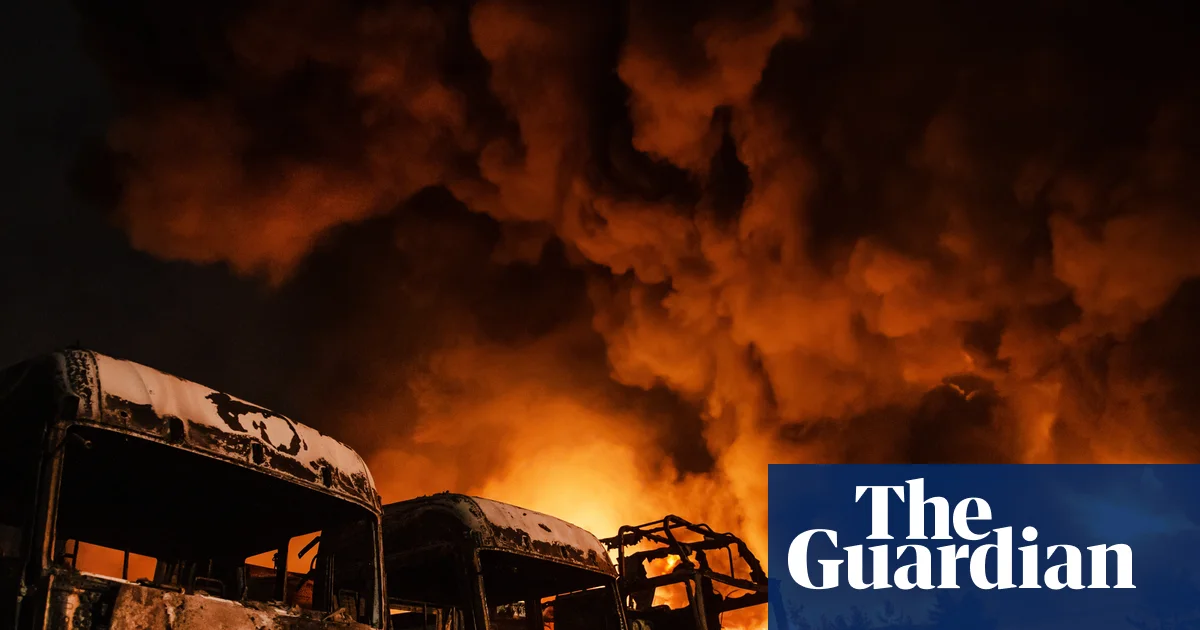
At least five energy sites in and around Tehran were hit by airstrikes, prompting accounts of “apocalyptic” scenes in the Iranian capital. Kuwait’s national oil company also announced a precautionary production cut amid retaliatory attacks by Iran.
The strait of Hormuz – one of the world’s most important trade arteries, through which about a fifth of global oil and seaborne gas tankers typically pass – has in effect been closed for a week.
Brent crude, the international benchmark, climbed as high as $119.50 (£89.40) a barrel – up 29% – as the new week’s trading began in the Asia Pacific markets, the first time market prices have soared above the key psychological $100 threshold since Russia’s invasion of Ukraine.
The increase narrowed, however, after reports that finance ministers from across the G7 group of developed economies would discuss a possible joint release of petroleum from reserves in an effort to tackle the surge in oil prices.
Later in the day, Brent crude was down to $85 a barrel. The West Texas Intermediate (WTI) benchmark price of US crude also dropped, going down to $86 a barrel after rising to $103 a barrel earlier in the day.
Before the swing, Trump said the extraordinary surge in oil prices is “a very small price to pay” for the US “and World, Safety and Peace”, the president wrote on Social Truth on Sunday. He described it as a short-term consequence of the US-Israel war on Iran, and claimed oil prices would “drop rapidly when the destruction of the Iran nuclear threat” was over.
The Iranian regime said US-Israeli strikes risked pushing prices even higher. “If you can tolerate oil at more than $200 per barrel, continue this game,” a spokesperson for the country’s Revolutionary Guard Corps (IRGC) said after the weekend’s strikes on energy sites.
Stock markets across Europe fell on Monday, with the UK’s blue-chip FTSE 100 index down 1%. The German Dax dropped by 1.2%, while the French Cac 40 was down 1.8%. The Stoxx Europe 600, which tracks the biggest companies across the continent, fell by 1.3%, erasing all of its gains in the year so far.Japan’s Nikkei 225 dropped 5% on Monday, as South Korea’s Kospi slumped 6.6%. Australia’s ASX 200 finished a volatile day of trading down 2.9%.
Adding further instability to the markets, Bahrain’s state oil company declared force majeure for its shipments after an Iranian attack set its refinery ablaze.
The state-run Bahrain News Agency (BNA) carried the announcement of the force majeure, a legal manoeuvre that releases a company of its contractual obligations because of extraordinary circumstances. BNA said the company’s operations had been “affected by the ongoing regional conflict in the Middle East and the recent attack on its refinery complex”. It added that local demand could still be met.
Oil prices returned to triple digits after the highest weekly gains since the Covid pandemic six years ago, and included a $10 increase in the price of US crude on Friday alone.
“The grace period given by the market to the Trump administration expired at the end of last week,” according to Clayton Seigle, a senior fellow at the Center for Strategic and International Studies.
“A deficit of 20m barrels per day is hitting global [oil market] balances with no sign of relief. To the contrary, President Trump is demanding unconditional surrender, a very unlikely prospect. While observers may have initially thought his disregard for painful oil prices was a bluff, it’s now clear that it isn’t,” he said.
The Trump administration has tried in recent days to reassure investors that the recent disruption within the oil and gas industries will not last long. “In the worst case, this is a weeks, this is not a months thing,” the US energy secretary, Chris Wright, claimed on CNN on Sunday.
Such statements appear to have been ignored.
Overall, oil prices have rocketed by two-thirds from just above $60 a barrel at the start of the year. Prices had already risen in January and February, before accelerating after the US-Israeli attack on Iran just over a week ago, which has disrupted a vital trade route for Middle Eastern oil supplies through the strait of Hormuz.
Fears of a global oil shortfall were compounded late last week by Qatar’s energy minister, who predicted that if the war continued unabated all Gulf energy exporters would be forced to shut down production within weeks and oil would rise to $150 a barrel.
Oil storage facilities in Saudi Arabia, the United Arab Emirates and Kuwait are reaching their limits, meaning large oilfields may need to be shut down if crude cannot be exported via the strait of Hormuz to the global market.
Hundreds of tankers attempting to transit the strait have come to a halt after the IRGC threatened to “set ablaze” any vessel using the trade route, which carries a fifth of the world’s oil and liquefied natural gas.
The White House has suggested countermeasures such as rerouting Saudi oil via the Red Sea, drawing on emergency US crude reserves or extending government-backed insurance to shipping companies. However, Seigle added that this would not be enough to offset the loss of 20m barrels of oil a day “or anywhere in that ballpark”.
Across Asia, which is particularly reliant on energy imports from the Middle East, countries are scrambling to mitigate a supply crisis.
South Korea announced a cap on domestic fuel prices for the first time in nearly 30 years. The current crisis “is a significant burden on our economy”, its president, Lee Jae Myung, said, “which is highly dependent on global trade and energy imports from the Middle East”.
Lee also said South Korea would search for energy sources beyond supplies shipped via the strait of Hormuz, and that a 100tn won (£50.24bn) market stabilisation programme should be expanded if needed.
Bangladesh announced plans to close all universities from Monday, bringing forward the Eid al-Fitr holidays as part of an emergency bid to conserve electricity and fuel.







Leave a Comment