

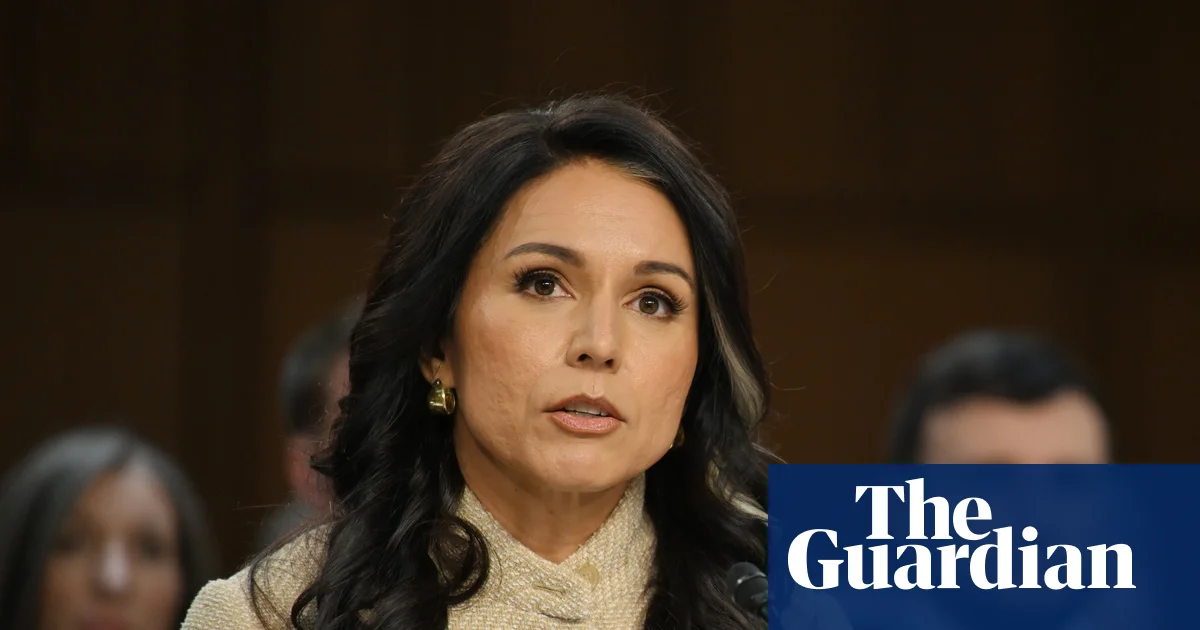
Tulsi Gabbard, the director of national intelligence who in 2019 was selling “No War With Iran” T-shirts, told the Senate intelligence committee on Wednesday that US strikes on Iran had been a strategic success.
“I’d like to remind those who are watching what I am briefing here today conveys the intelligence community’s assessment of the threats facing US citizens, our homeland and our interests,” Gabbard told the committee, “not my personal views or opinions”.
Iran’s retaliatory strikes to the US-Israeli campaign have already killed 13 American service members and wounded approximately 200 more, cost taxpayers billions of dollars and scrambled global supply chains for oil, fertilizer and aluminum. This week, when Donald Trump asked allies to help reopen the strait of Hormuz, the call wasn’t answered.
According to the annual global threat assessment report, Iran’s conventional military projection capabilities had been “largely destroyed”, Gabbard said, and Iran’s strategic position “significantly degraded”. But, the regime appears intact, and since internal protests have been violently suppressed with thousands killed, if it survives, Iran would probably “seek to begin a years-long effort to rebuild its military, missiles and UAV forces”.
In last year’s assessment, the intelligence community assessed that “Iran is not building a nuclear weapon and that Khamenei has not reauthorized the nuclear weapons program he suspended in 2003, though pressure has probably built on him to do so.”
The 2026 assessment also said that missile threats to the US homeland were projected to grow from roughly 3,000 to more than 16,000 by 2035, that North Korean hackers stole $2bn in cryptocurrency last year, and the Islamic State is actively rebuilding in Syria.
But it was what the assessment did not say that drew the sharpest response. Senator Mark Warner of Virginia, the vice-chair of the intelligence committee, noted that for the first time since 2017, the assessment contained no mention of adversary attempts to influence American elections.
“I don’t believe this omission means that the threat has disappeared,” Warner said. “It means that the intelligence community is no longer being allowed to speak honestly about it.”
In response to questioning from Warner, Gabbard said that she did not “participate” in the FBI seizure of 2020 election documentation in Fulton county, but was present “at the request of the president, and to work with the FBI to observe this action that had long been awaited”.
Warner had asked Gabbard what she was doing there, given that the criminal warrant “showed no foreign interference or nexus. As a matter of fact, the warrant was based on conspiracy theories that have already been examined and rejected repeatedly.” Warner was one of the earliest and most vocal critics of the Fulton county action by the FBI.
Gabbard asserted that her directorate hd authority to investigate threats of foreign interference on elections, referring to a letter sent to Congress shortly after the FBI raid. She said Trump sent her to observe, but added that she had no prior knowledge of the contents of the warrant affidavit, and that she was “not aware that the president knew about an affidavit before it was served”.
“Then why was he sending you to Fulton County?” Warner asked.
“This occurred the day that the FBI had approved their warrant, approved by a local judge, and they began to execute this,” she replied before quickly moving on to other topics.






Leave a Comment