

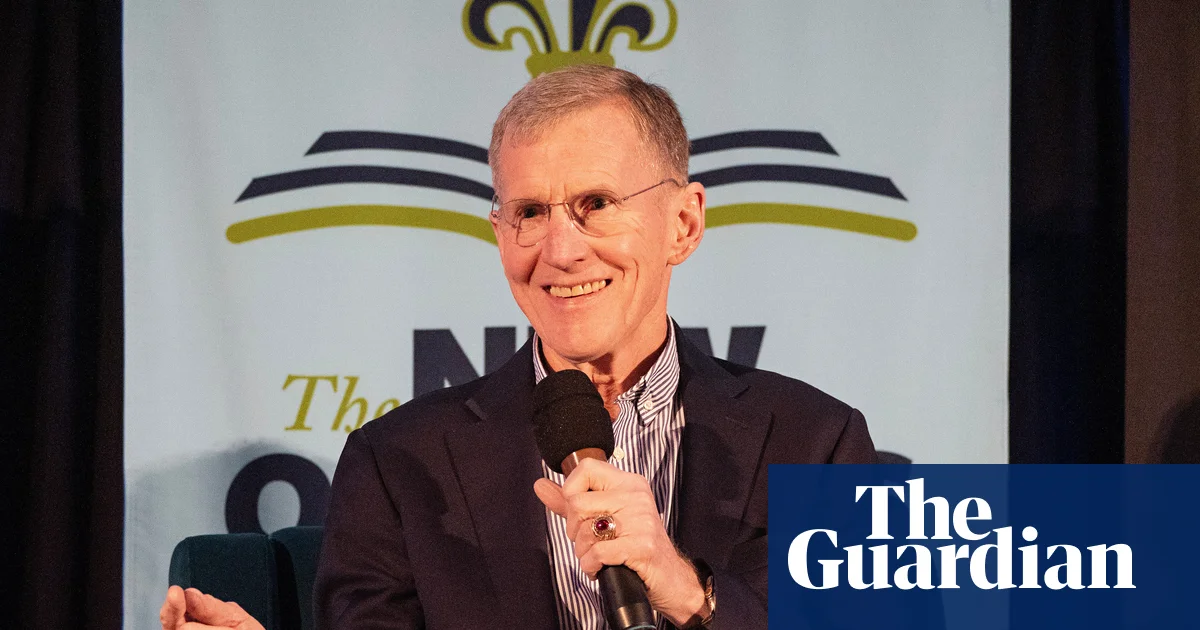
The retired US army general who once led Nato forces in Afghanistan says the bellicose foreign policy Donald Trump has pursued during his second presidency can be summed up as “we should do because we can” – invoking the lyrics of the Dolly Parton classic Jolene to emphasize the point.
Stanley McChrystal delivered those remarks on Friday at Tulane University’s New Orleans book festival during a fireside chat hosted by the editor-in-chief of the Atlantic, Jeffrey Goldberg, who asked in part about US military strikes Trump has ordered in Nigeria, Venezuela and Iran since Christmas.
“I’m a big fan of Dolly Parton – do you remember her song Jolene?” McChrystal replied, referring to the country star’s Grammy-nominated 1973 hit. “This poor wife says, ‘Jolene, please don’t take my man; don’t take him just because you can.
“And that’s what worries me – I think we might be in a period where we think what we can do, we should do because we can. And I think the world is starting to view us that way.”
McChrystal’s commentary about what he dubbed Trump’s “Jolene doctrine” is bound to carry weight in many political circles, as the retired general spent his entire career in the US army upon graduating from its West Point academy in 1976.
Later, as a special forces officer, he was credited with prominent roles in the US’s capture of Iraqi dictator Saddam Hussein in 2003 as well as the 2006 killing of the al-Qaida leader in Iraq, Abu Musab al-Zarqawi.
McChrystal subsequently commanded US and Nato military alliance troops in Afghanistan for a little more than a year beginning in June 2009 during Barack Obama’s presidency. He ultimately had to resign from that post after making disparaging remarks to a Rolling Stone magazine journalist profiling him about the US’s civilian leadership, including Obama and his eventual Democratic White House successor, Joe Biden, the vice-president at the time.
Obama replaced McChrystal with Gen David Petraeus, who later resigned as director of the US’s Central Intelligence Agency over an extramarital affair with his biographer.
The Atlantic reported later on Friday that a White House spokesperson responded to McChrystal’s comments by saying the president had restored the US’s “place as leader of the free world”.
Among others, the publication also quoted the University of Missouri’s Jay Sexton, a historian of American foreign relations, as saying: “I think the Trump team is acting like an unbridled Jolene – they’re doing things because they can.
“But the bummer is to carry the metaphor: Jolene is likely to regret doing what she thinks she can.”
The US’s Christmas strikes in north-west Nigeria were aimed at what the Trump administration described as fighters for the Islamic State terror group, though there were questions over which group was specifically targeted and the operation’s impact.
Then, on 3 January, the US attacked Venezuela and seized its ruler, Nicolás Maduro, whom Trump’s justice department had charged with drugs, weapons and narco-terrorism charges.
Israel and the US then jointly attacked Iran on 28 February, killing the country’s supreme leader, Ayatollah Ali Khamenei.
The ensuing conflict has been marked with mixed signals about what Trump would consider victory, confusing his constituency, allies and foes. The president has also spent time trying to deflect responsibility for the bombing of a girls’ school in southern Iran, which killed at least 175 people, mostly children.
Amid all that, Trump renewed threats to seize Greenland for the US with military action if necessary. He ultimately walked those threats back but was widely seen to have strained the US’s relations with its Nato allies.
Goldberg on Friday told McChrystal that he feared the world has not heard the end of Trump’s fixation with Greenland.
“I’m a great believer in allies,” McChrystal said in turn. “To me, that’s the sacred kind of relationships that are essential for any nation. We’ll never be powerful enough to go it alone.”






Leave a Comment