

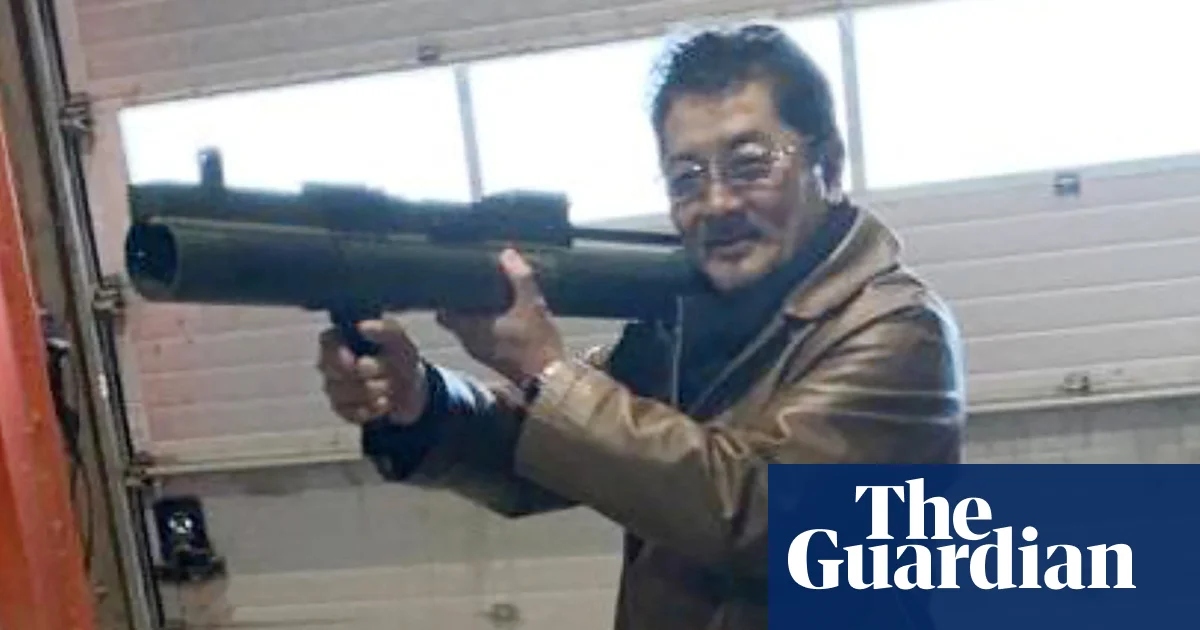
A plot to supply Iran’s nuclear weapons program, heroin from the Golden Triangle, Burmese ethnic insurgents and rocket launchers were the subject in courtroom 24A in New York’s federal courthouse last week when a man described as a leader in Japan’s Yakuza organized crime syndicate was sentenced to 20 years in prison.
The transnational plot, which the US Drug Enforcement Administration had been investigating since 2019, involved Japanese organised crime leader Takeshi Ebisawa, who along with three Thai men, had been arrested in New York in 2022.
In court last week, Ebisawa, 62, pleaded guilty to six counts of conspiracy to traffic nuclear materials, including uranium and weapons-grade plutonium, from Myanmar to other countries, as well as his participation in international narcotics trafficking, weapons and money laundering.
According to prosecutors, Ebisawa had arranged to sell an undercover DEA agent large quantities of heroin and methamphetamine from Myanmar’s rebel United Wa state army, and then sought to buy automatic weapons, rockets, machine guns and surface-to-air missiles, some taken from US military bases in Afghanistan, for Sri Lanka’s Liberation Tigers of Tamil Eelam and Myanmar’s Karen National Union, Shan State Army and United Wa state army.
But it wasn’t the 1,100lbs of drugs, known as “cake and ice cream” in Ebisawa’s intercepted communications, or even the weapons, including surface-to-air missiles, known as “bamboo”, but the trafficking of nuclear materials that attracted the attention of US prosecutors in the southern district of Manhattan.
“The illicit trafficking of nuclear materials is an existential threat to every New Yorker and every American,” said US attorney Jay Clayton. “Ebisawa tried to sell uranium, thorium, and plutonium to fuel a purported nuclear weapons program, along with deadly drugs destined for US streets. In exchange, Ebisawa hoped to procure battlefield weapons for insurgent groups and profit for himself.”
According to the complaint, Ebisawa had unknowingly been introduced by a source to an undercover DEA agent, posing as a narcotics and weapons trafficker, to his international criminal network that spanned Japan, Thailand, Myanmar, Sri Lanka and the US.
Ebisawa, the government said, conspired to sell uranium and plutonium to a DEA agent posing as an Iranian “general” in charge of Iran’s nuclear weapons program.
Asked whether the uranium was enriched above 5% because the Iranian government needed it for nuclear weapons, Ebisawa said: “I think so and hope so.” He later forwarded an email in the name of a mining company offering 50 tons of uranium U3O8 concentrate powder known as “yellowcake” for $6,850,000.
Ebisawa provided photographs of samples, alongside a Geiger counter measuring radiation, and promised the “general’ that the “plutonium” that would be even “better” and more “powerful” for Iran’s use. Prosecutors said the nuclear material came from an unidentified leader of an “ethnic insurgent group” in Myanmar who had been mining uranium in the country.
Samples of the nuclear materials were obtained and a US lab found they contained uranium, thorium and plutonium, and that “the isotope composition of the plutonium” was weapons-grade.
But Jake Adelstein, author of Tokyo Vice: An American Reporter on the Police Beat in Japan, says that his research into Ebisawa did not produce a connection to any Yakuza groups. “He’s just a conman who was probably introduced to the DEA running a sting operation as a Yakuza and they ran with it,” Adelstein adds. “Ebisawa definitely has a history of being a conman. Even his friends who like him say it.”
The prosecution, part of the Organized Crime Drug Enforcement Task Forces (OCDETF) operation, comes at a moment of heightened tensions around nuclear materials that have fallen out of regulatory control.
David Kenneth Smith, a former nuclear security officer at the International Atomic Energy Agency (IAEA) and now at the Stimson Center supporting nuclear security initiatives, calls the Ebisawa case “a perfect confluence” of international nuclear trafficking co-operation that he calls “a resounding success”.
But, he says, the case has highlighted “something that all of us in the business worries about – material that was out of regulatory control and an exemplar of what we need to be very serious about”.
Established smuggling routes within the Golden Triangle – the border region including Myanmar, Laos and Thailand – or along the western edge of the Black Sea have been made more porous to criminal activity by weakly protected, or “green”, borders, lack of coverage of radiation detection, and customs workers who are ill-trained or poorly equipped.
“Whether it’s guns, narcotics or nuclear materials, they all get commoditized – and nuclear was the big thing after the breakup of the Soviet Union,” Smith said, adding that this is particularly so at a time of disruptions in the interactions among governments, conflicts and terrorist networks, “placing stress on systems we have set up”.
“There’s so much going and what worries us is that you have these networks, they have their forces, their transit pathways, they have their potential buyers. In the Golden Triangle or in Ukraine, it’s a harder job to ensure that all this material will be protected,” Smith said.
The Vienna-based IAEA lists 4,390 incidents since 1993 in which nuclear and other radioactive material is or was out of regulatory control, but only 343 incidents that are, or are likely to be, connected with trafficking or malicious use.
While the DEA used an Iranian “general” as a decoy, Ebisawa’s guilty plea comes as the US and Israel are attacking Iran, in part due to its nuclear program – though Iran denies it has any intent to build a nuclear weapon.
“It’s a mysterious situation because there isn’t any plutonium to speak of in Myanmar,” said Matthew Bunn, professor of the practice of energy, national security and foreign policy at the Harvard Kennedy School. “Yet the sample he gave the DEA agent is described as containing detectable quantities of thorium, uranium and weapons-grave plutonium.”
“That phrase suggests very small quantities,” Bunn added. “So it raises the question of where did that stuff come from and, as with most smugglers, he claimed to have more, so is that true? Did he have access to substantial quantities? There aren’t answers to either of those questions.”
Moreover, most cases of nuclear smuggling come from Europe, mostly in the 1990s and 2000s, including the seizure of 1.5kg (3.3lbs) of 90% highly enriched uranium (HEU) in Podolsk, Russia, and the seizure of a thermos-shaped lead cylinder of HEU seized in Moldova in 2011. The material appeared to have come from a restricted military installation in Russia.
“In some cases, it’s some fool who got hold of the material wandering around looking for a buyer,” Bunn said. “In others, it’s a middleman who thinks they’re connecting with a buyer but is a sting agent, but in this case it’s primarily a drug smuggler with a side of arms and little bit of nuclear material.”
Ebisawa’s prosecution was led by the OCDETF. At the time of his arrest, then-DEA administrator Anne Milgram said Ebisawa had offered the uranium and weapons-grade plutonium “fully expecting that Iran would use it for nuclear weapons”.
With the war on Iran threatening a potential collapse of the Iranian government, nuclear forensic experts have new grounds for anxiety of the spread of dangerous material.
“The worst-case scenario is complete loss of control of highly enriched uranium,” said Bunn, who wrote a paper on the issue last year. “The collapse of a state with several bombs’ worth of highly enriched uranium is a nervous-making thing,” he added, referring to Iran. “You can easily imagine that if you’re the guy with access to whatever highly enriched uranium the government still has access to, you may be looking for a golden-parachute.”








Leave a Comment