

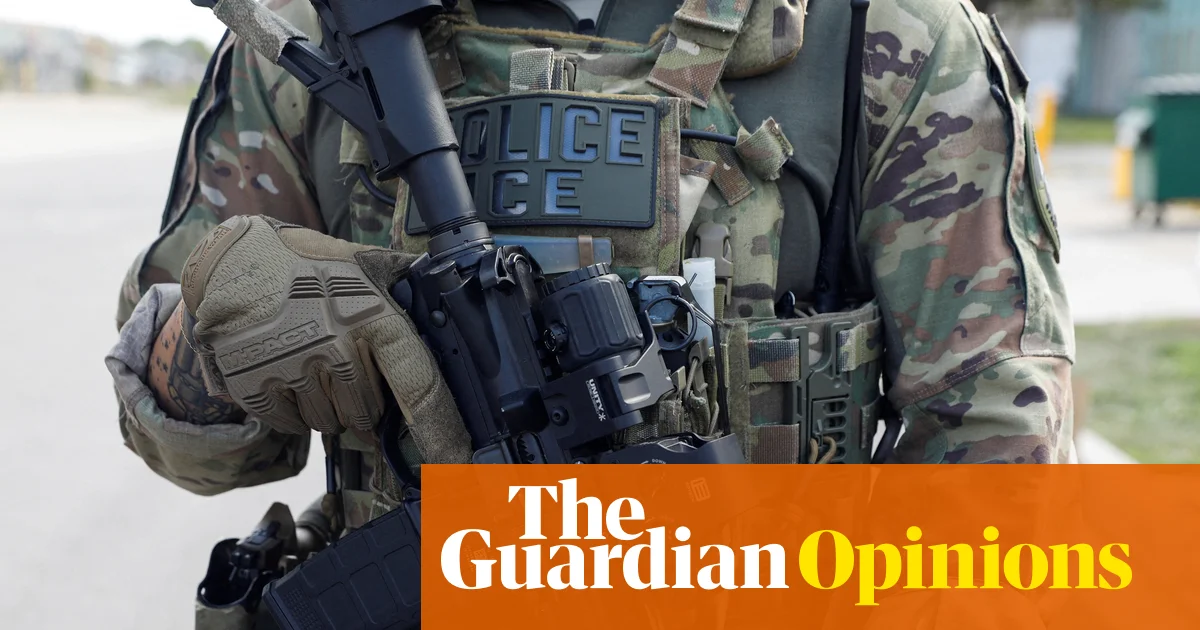
There is snow on the ground, but for some Chicago families, this is a moment of unfreezing. ICE is still out there, but Commander Gregory Bovino and his strike force have moved on. After months, Operation Midway Blitz has quieted.
In places like the elementary school where I am principal, some parents who were hiding are poking their heads out doors. Children holding their breath since September are beginning to exhale.
But the danger isn’t over; it’s just somewhere else. LA, Washington DC, Chicago. Then Charlotte, New Orleans Minneapolis.
News stations call them “stings” and “sweeps” and “crackdowns” – words that suggest a line between those in and out of focus: targets and civilians, innocent and guilty.
But in one Chicago school, a third grade boy stopped eating because he was afraid to type in his lunch code, worried ICE would somehow see it and know where he was, or his family.
In another, agents entered a schoolyard in the middle of the day and took a landscaper while children were inside learning.
The Department of Homeland Security says these operations target “gang members, rapists, kidnappers, and drug traffickers”, the “worst of the worst” and “Criminal Illegal Aliens Released From Jail and Back into American Communities”.
They want us to imagine dark strangers who put others in danger. Trump himself calls immigrants “animals” and “rough people” who are “poisoning the blood of our country”.
But when they talk about immigration, they are talking about our students. About you, or your grandmother. Your neighbor. People who walk their kids to school.
Most years, my job is to make sure we have enough copy paper and to observe classes, such as the room I visited on Halloween when a teacher dressed like a Teletubby read aloud to eighth graders from The Tell-Tale Heart.
This year, in the same building: a student who had begun barricading his bedroom door each night, terrified agents would appear; a mom in the hallway whose eyes welled with tears when I asked: “How are you?”, and who said to me: “I’m just so scared.”
I am in awe of her, and her children, who have spent months living through terror: doing math homework. Bringing cupcakes for a class party. Holding their breath each time a car turns down the street.
In every classroom on Earth, good and bad things happen every day. Working in schools means existing in contradiction: children are resilient. And also, they remember.
One in five Chicagoans is an immigrant. One in 12 Chicago households includes someone undocumented.
What does it feel like for your child to ask who cares for them if you are taken? To go to school in the morning worried your parents won’t be there when you get home?
How can you call an operation targeted when it blankets a city in fear?
Since September, federal officers have arrested more than 4,000 people in Chicago and nearby towns: masked agents, trucks with dark windows, people taken so suddenly at least one left a car in the street with the keys still in it.
Agents detained children and arrested US citizens, say reports. They killed a man, and shot a woman. They used teargas and other chemical agents 49 times, according to a media investigation. Video showed an agent firing pepper balls at a pastor.
But a report early this month identified just a fraction of those detained as having criminal arrests or convictions.
None of us knows yet what effect this will have on our children, or their families, or our city. But that’s a reckoning we will have to face soon: here, and in every town that’s next.
I don’t begrudge the places Trump so far passed over, but that was never going to be Chicago. Not this city, built by immigrants, where our mayor and governor remain defiant. Not Chicago, where immigrant leaders and allies built a model for fighting back: filing lawsuits, blowing whistles, buying groceries and driving one another’s kids to school.
But as hopeful – and difference-making – as those stories are, you can’t feel good in this moment. You don’t tell a child “it’s OK” when it isn’t, and it won’t be.
What you say is: this is awful. What you say is: I am sorry. What you say is: we are going to try to make things better.
The writer Nelson Algren once said loving Chicago is like loving a woman with a broken nose. I always thought that line was sexist – that Algren meant Chicago, like the woman, was imperfect: less than beautiful.
I hear it differently now. A nose that’s been broken means a person who’s been punched.
That’s what this was: not a sweep or a strike or a crackdown, but a fist thrown out. A beating. That’s what our city took: a beating.
But Chicago is still here.









Leave a Comment