

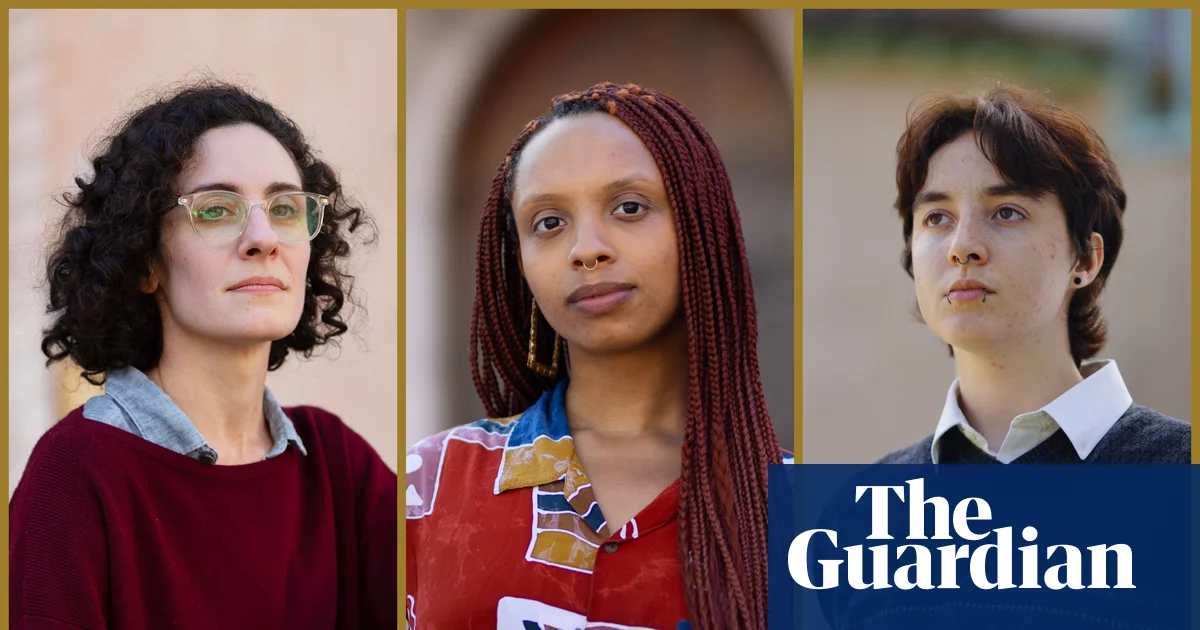
On a Tuesday night, at Florida’s only public liberal arts college, a small group of students gathered in a classroom to discuss issues deemed “controversial” on state campuses: transgender rights, feminism, immigration. But perhaps what they wanted to address most was how to combat despair.
“It’s important to stand and resist,” said Nya Jacobson, a New College of Florida senior. “But this place is a lost cause.”
As part of a broader push of anti-LGBTQ legislation in 2023, Ron DeSantis, Florida’s governor, forced a big conservative shift at New College, considered the state university system’s queerest campus. His newly appointed school board of trustees ousted the college’s female president and multiple LGBTQ+ staffers, and voted to end its gender studies department, creating a mass exodus of students and faculty. In the three years since, the culture change has solidified, resulting in a more reserved, atomized student body and a new roster of conservative professors.
On this February evening, though, Lux, a socialist feminist magazine, was hosting a discussion to remind students that not all hope is lost. With speakers from activist organisations like 50501, one of the groups behind the No Kings protests, Lux Magazine is on a multi-city college tour in states with academic bans around race, gender and sexuality and restrictions around bodily autonomy. The magazine wants to show Black, brown, queer, feminist and trans students that they still have a safe space on campuses, and adults have their backs.
Even Jacobson, who felt defeated after years of pushing back against the school administration, was reminded of all that’s still left to fight for.
“It’s really helpful to talk to organizers and be like, ‘Wow, people are doing things,’” said Jacobson. “All you hear is bad news, so it’s like, damn, there are people out here fighting for us, and they live right here.”
What’s happening at New College is not an anomaly: the school is just one of 445 campuses across 48 states and DC that have changed their diversity, equity and inclusion (DEI) policies or academics in response to state legislation in the past three years, according to the Chronicle of Higher Education. In states like Iowa and Texas – other stops on Lux’s campus tour – schools have similarly experienced the installation of political appointees into college administration, followed by academic bans, restrictions on student social life and a purge of anything associated with “diversity”. But at the tiny, once quirky New College in Sarasota, the shift in value systems, practically overnight, hit especially hard.
Jacobson, the president of New College’s LGBTQ+ club, is struggling to find another student to take over the club once they graduate. The school mascot, once the “null set”, a pair of closed brackets with a space in the middle, is now the Mighty Banyans, illustrated with an uncannily macho tree named Rooty. Once a school where students organized a tree-saving protest named after a Dr Seuss character, the college is now investing scholarship money into recruiting student athletes, demolishing trees for a new baseball field.
The conservative takeover of New College began less than a year after DeSantis signed the “don’t say gay” bill into law in 2022, barring discussion of LGBTQ+ topics in primary education. One of the six conservative trustees DeSantis appointed was Heritage Foundation fellow Christopher Rufo, best known as the architect of the manufactured backlash to critical race theory. The new school president was DeSantis ally Richard Corcoran, who had no prior experience in higher education. On top of disbanding the gender studies department, the board announced its intentions to “de-feminize” the student body, which, like higher education itself, skewed majority women. When the new administration drove up student enrollment for the fall 2023 semester by recruiting male athletes, it tanked the school’s average GPA scores for the 2023 incoming freshman class.
Students and professors at New College tried to fight the changes, but many were pushed out. In the fall of 2023, more than 100 students, roughly an eighth of the student body, transferred to another school. Forty per cent of the school’s professors also left before the fall semester; those who came in their stead included a “presidential scholar in residence” who once wrote a paper called The Case for Colonialism.
Students who stayed, like Jacobson, faced finishing their degrees with few to zero professors in their department. Still, Jacobson didn’t blame the new students, many of whom, they suspected, didn’t know what happened and “are getting screwed over in a different way”.
“People often paint them as part of the problem,” Jacobson said of the new students. “But it’s like, no, the problem is people are trying to get an education, and it’s really hard to do that here.”
Lux’s New College event was a much different vibe from its stops at Florida International University in Miami and the University of Central Florida a week earlier. For those conversations, students came prepared with their own campaigns and strategies – around ICE, the cost of housing. At New College, students were so beaten down that one was unsure if protesting was legal.
Sarah Leonard, Lux’s editor-in-chief, understood that the mood at New College was likely going to be more deflated than at other schools. In the five years since Lux’s launch, the magazine has covered attacks on higher education.
“We found that while some of these issues were being covered in the media, often student voices were not at the center of those stories,” Leonard said.
Lux’s campus tour is part of its efforts to continue the feminist tradition of bringing people together to strategize and organize. Probably the most recognized name in college tours in recent years is Charlie Kirk, the Turning Point USA CEO who was killed in September. Kirk became famous for his consistent presence on campuses, where he often countered progressive arguments with bigoted rhetoric. His engagement with young men – on campus and online – is also often credited with handing Trump the 2024 election. The Lux tour flips Kirk’s “debate me” campus approach to create a space for students – queer, marginalized and otherwise – to talk about what matters to them.
Lane Hagan, a New College junior, opened up about having a professor who made offensive comments about race, gender and sexuality during class, antagonizing students with the sort of “blue hair and pronouns” jokes about liberals invoked on Fox News.
Hagan’s mother went to New College and told them, “‘You’re gonna finally have this community,’” said Hagan, who grew up in a rural, conservative Florida town. “‘You’re gonna have these professors that are gonna have these amazing ideas’ … and I was really excited for that.”
Hagan continued: “I kind of expected to come here and get even more gay looking, and to express myself even more. I feel like it’s gone in the other direction.” After hearing the professor’s jokes, Hagan said they stopped dyeing their hair, which they had been doing since they were 12.
Given the school’s climate, students told the Lux team they didn’t know how to begin organizing when they also didn’t know where they were safe to talk about organizing.
“Students are scared to get involved, to invite groups like us,” said Noella Williams, Lux’s campus tour organizer. “We’re just a magazine.”
Williams, 26, was a student organizer before she graduated from Florida A&M University (FAMU), the state’s only public historically Black college that recently announced it was “consolidating” its African American studies program. Now working at Lux Magazine, Williams feels the pain of the students she meets. She called the experience of being an organizer on an HBCU campus in Florida “isolating”.
Williams said: “I feel really grateful that students can talk to me and ask questions because I didn’t really have something like this when I went to FAMU.”
At the event, speakers like Jules Rayne of Equality Florida, the only statewide trans organizer, and Sarah Parker, with the advocacy group Voices of Florida and a national coordinator for the 50501 movement, also provided local, supportive, adult voices that students could connect with in the future.
Rayne said: “If you all want to protest here at New College, we will join you, and we’re going to loop in every other org about a protest.”
Rayne also mentioned that though the losses seem constant, there were also wins: “Last year, we defeated every anti-LGBTQ+ bill in the state of Florida,” Rayne said to students’ cheers.
While graduating students like Jacobson say their fight for their school is over, new ones are still arriving, not yet embittered and full of conviction. Luci Pimienta, who had only been on campus for a few weeks, was doggedly recruiting at the event to start a progressive club. Organizers on the panel told her they would happily help her find a space for it if the campus wouldn’t allow it.
“It’s building power,” Parker said. “I always say, each one of you has a friend. They have a friend. We all have to lock arms and do this together.”
At the end of the night, some students peeled off to do homework, while others stuck around to chat. The Lux campus tour continued on to the University of Iowa, where more than 80 students showed up at the two-day event, fired up about what to do over their recently shuttered gender studies program.
While the magazine doesn’t pretend to have all the answers to the challenges facing marginalized groups in higher education, the Lux team believes that students can find a way forward with a supportive, safe environment – even if it’s just for a few hours.
Hagan said: “I don’t know if there’s anyone who’s speaking to us other than a panel like this.”









Leave a Comment