

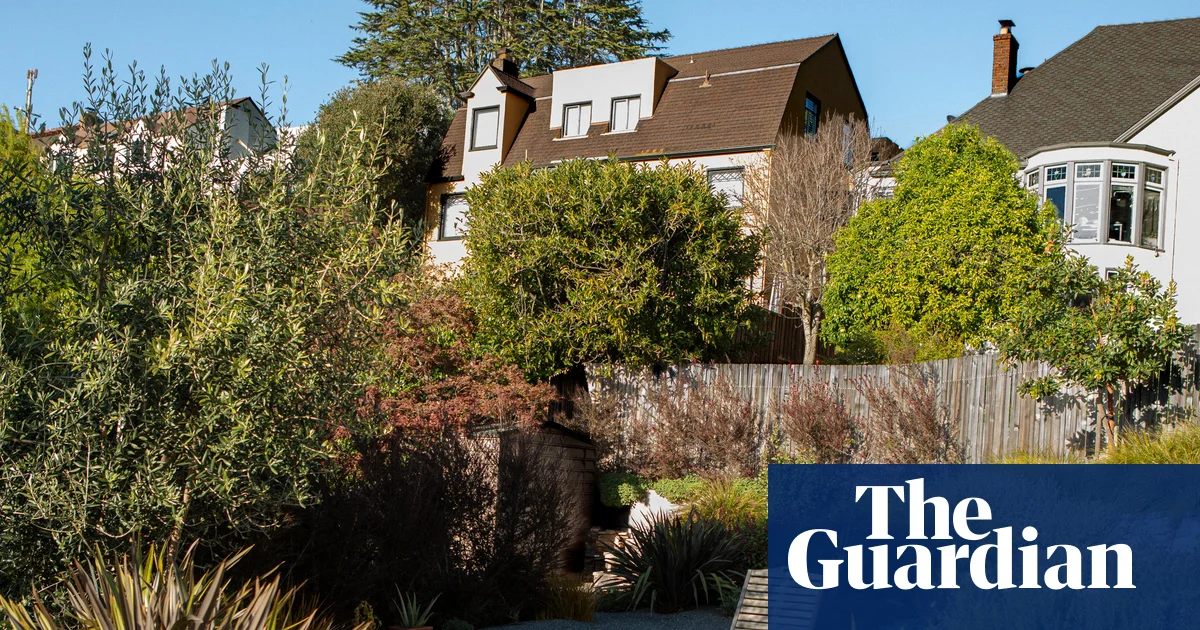
Michel Thouati went through the five stages of grief before he ripped his beloved fig tree from the earth. There was a persimmon and an elderberry too, nestled close to his hillside home in Berkeley,California, and they all had to go.
The plants thriving on his small property had become overshadowed by the dangers growing with them: an emerging body of research had found landscaping can help fuel the disastrous fires sweeping out of the wildland and into neighborhoods like his. Tucked into the ridges overlooking California’s San Francisco Bay and against an expansive nature area, the house Thouati and his wife have owned for 30-some years sits in one of the highest wildfire-threat areas in the state.
A scientist with a penchant for diving deep, he poured into the research. Hundreds of articles later, he said, “it became clear I had to swallow my pride”. After years of planning and planting, he added, “I had done it all wrong.”
As the extreme conditions fueled by the climate crisis push wildfire threats deeper into urban areas, scientists, officials and residents who live on the front lines have zoomed in on the flammable features lingering close to a structure. Berkeley is among the earliest adopters of so-called “Zone 0” regulations, new mandates that require the first 5ft around homes in the highest-risk areas be cleared from anything combustible, a strategy meant to stop falling embers from igniting.
While the idea is gaining interest, questions have swirled around the specifics. The science is complicated and – like most things in an era of changing conditions – hard choices are baked into its conclusions. The challenges are an example of how the climate crisis has rewritten risk, prompting questions about what communities are willing to sacrifice for a sense of safety and control.
Pushback against culling cherished plants
It’s generally agreed that wood fences and trellises providing pathways for fire between homes should be removed. People take little issue raking up the piles of mulch where falling embers can easily ignite into new fires, clearing debris from their gutters, or even replacing their roofs.
It is plants that have posed the biggest problems.
From affordability and aesthetics to government overreach and lost shade, the concerns about culling landscaping are wide-ranging and voiced loudly. Amid the public pushback, deadlines have come and gone in the six years since California began working on regulations that would apply to structures most at risk across the state.
But the Los Angeles fire storm, a set of blazes that consumed thousands of homes and claimed dozens of lives in January 2025, brought the issues into sharper focus. Images of inflamed and thrashing palm trees that rained embers on roofs only deepened fears, while singed trees left alive within devastated cul-de-sacs inspired new scientific questions.
More than 1,000 areas in 32 states across the US have similar characteristics to the neighborhoods that burned in the LA fires and many are now watching closely.
Berkeley has chosen to forge ahead. The city council unanimously passed an ordinance last June that gives residents of roughly 900 homes in the highest-risk neighborhoods one year to begin removing combustible materials within 5ft of the buildings, with some allowances for well-tended mature trees, and pruned potted plants. The city will slowly step up enforcement in the coming months.
On a warm afternoon in March, lush vegetation celebrated in one of Berkeley’s storybook neighborhoods was still on full display. Along tightly winding roads, tree canopies draped delicately over awnings, vines climbed up siding and over fences, and colorful blooms splashed against foundations.
Brent Blackaby, a Berkeley councilmember, said he expects it will take time. Enforcement is more about education at this stage, and the city will not issue fines to those who are making an effort. There is also financial support for some residents in need, thanks to a $1m grant awarded to the Berkeley fire department and other local resources available for projects that protect against fire.
There is already a lot of interest in tools provided by the city, with hundreds of fire department inspections scheduled, Blackaby said. He is hopeful that success at homes high in the hills could help create enough defensible space to slow flames and protect their downslope neighbors, and that the ordinance will slow the sharply rising costs of insuring high-risk homes. Many residents have seen their premiums double and triple in recent years, or have been bumped off their longtime plans.
“We just can’t wait around because our turn could be next,” he said. With how closely spaced homes in these neighborhoods are “once one or two houses start to catch on fire – we are in a world of hurt”.
It’s a sentiment that’s spurred action in the area even before the threat of enforcement. Eric Weaver and Sara Sanderson were excited to point out the progress they’ve made. In less than a year, they’ve brought their self-proclaimed overgrown yard close to compliance, through a combination of clearing vegetation and relocating plants.
As members of one of the dozens of “firewise communities” in the area, nationally recognized groups of volunteers who organize to better prepare for fire, they said they were already tapped into networks and resources that helped them make adjustments.
Weaver is hoping his yard can serve as an example for how to clear potential hazards without sacrificing ambiance or ecosystems. “There was a drop in the amount of hummingbirds for a while, but they’re starting to come back now that we’re getting other plants out there,” Weaver said.
The work, he said, has also fostered deeper connections. It inherently requires communication; with homes situated so close to one another, trees and shrubs could pose problems to structures beyond property lines. For Zone 0 to be most effective, everyone has got to be on board.
‘It’s about increasing your chances’
Despite growing enthusiasm, there are still sharp divisions over the policy, both here and across the state, while debates over what might be lost or gained remain unsettled.
There’s widespread support for so-called “home hardening” strategies, which include installing less-flammable siding and sealing gaps and lining openings with small metal mesh on vents to stop embers from entering. But Dr Max Moritz, a wildfire specialist with UC Cooperative Extension, said there are still important questions to answer about both the risks and potential benefits posed by plants, especially those surrounding homes that tend to be better irrigated. He’s among a group of scientists cautioning against broad policy decisions made with uncertainty.
“The nuances and tradeoffs have been glazed over,” he said. “If you want to view vegetation as a hazard – which I think is oversimplifying the problem – what about all the benefits vegetation can play during the decades before a fire exposure even happens?”
Moritz and Dr Luca Carmignani, a fire scientist and assistant professor at San Diego State University argued in an op-ed last June that some plants might actually help slow the spread of flames started by wind-blown embers. The piece set off a firestorm of its own with comments on social media, the two lamented, emphasizing that questions remain on both sides. That’s the point they were trying to make all along.
“We just know about the extremes,” Carmignani said. “One of the risks of the legislation is to create a black-or-white approach when we’re still in a gray area.”
Dr Edith de Guzman, a cooperative extension specialist in adaptation policy who has closely studied impacts from the climate crisis on communities, agrees. Her concerns extend beyond the wildfire crisis, and what could be lost if plants that soften other threats in a warming world, including extreme heat and hydrology, are sacrificed – especially if their role as culprits isn’t a sure thing.
“I’m afraid we’ll look back and say, wow, we really took an ax to a problem when we should have taken a scalpel.”
Dr Michael Gollner, associate professor of mechanical engineering at the University of California at Berkeley, thinks the policies have the potential to protect more homes, based on his research. Even if there are some pitfalls, he said, that’s the ultimate goal. “Zone 0 is a compromise,” he said, emphasizing that what’s already built is much harder to change than what’s around it. “It’s where we get the most benefit for the least amount of work.”
With a team at the school’s Fire Research Lab he developed a model that was the first to fully reflect how fire moves through structures. They also analyzed how more than 47,000 buildings fared in five major California fires between 2017 and 2020 found that fully embracing Zone 0 increased the chance of survival of a home from 20% to 37%.
“It’s not an absolute, it’s about increasing your chances,” he added. “We’re losing insurance, we’re losing affordability. We’re risking not just neighborhoods, but we’re risking lives too – and we don’t have an easy pill to swallow that just does everything.”
It’s a message Thouati, and the neighbors who have become evangelists for the new regulations, have taken to heart. He is haunted by what happened in Los Angeles, and the memories of the 1991 Oakland Hills fire which killed 25 people living in the adjoining hills.
“It’s a beautiful neighborhood and I love the place – I really don’t want to move,” he said. “But until it is safer, if a wildfire comes our way, we won’t make it.”
And, despite the painful moments that came with ripping out the peaceful garden he once tended, he’s proud of his carefully planned greenery. Still a work in progress, bags of differently colored rocks are piled in the corners, where they will set fire breaks between groups of plants. One day, a now small dogwood tree will shade his yard from a safer distance, he said, and sprout enormous white flowers each spring. He’s even picked out a spot where he will plant another fig tree.
The changes have felt fruitful, but haven’t fully assuaged his fears. Thouati reiterated the research that Zone 0 is most protective when applied at scale. He’s placed his hopes in his city’s regulations.
“When there are no requirements, if you end up doing everything right and your neighbors do nothing – you are pretty close to nowhere.”







Leave a Comment